
A dog toothbrush vs finger brush decision should come down to fit, reach, control, and what your dog calmly accepts. A handled toothbrush usually reaches the back teeth more easily and keeps fingers outside the mouth. A finger brush gives close tactile feedback but can be bulky in a small mouth and is appropriate only when the dog is comfortable with a hand near the teeth.
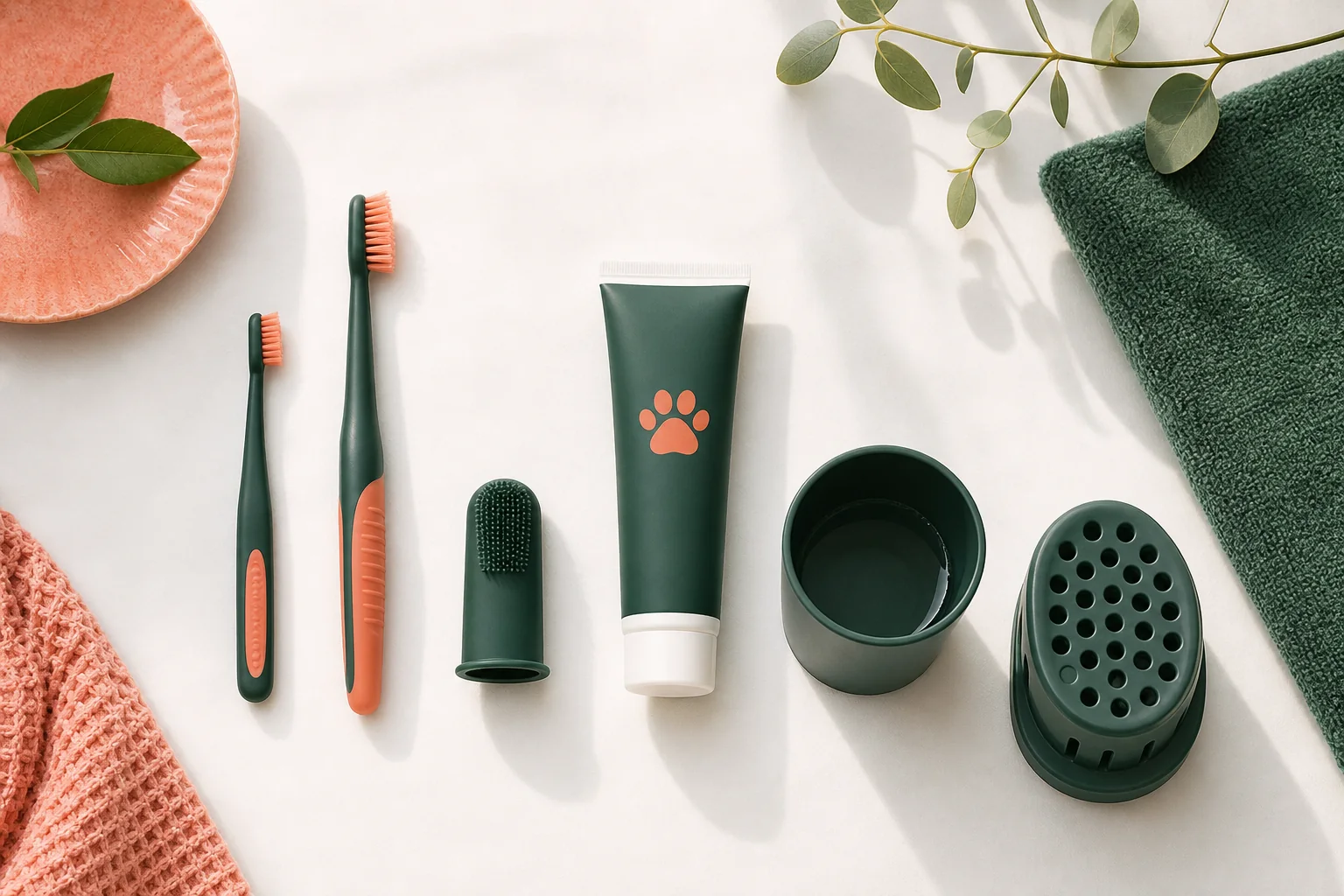
Quick Comparison
| Feature | Handled dog toothbrush | Finger brush |
|---|---|---|
| Reach | Usually better for back teeth | Best for accessible front and side surfaces |
| Control | Stable handle keeps fingers outside the mouth | Close feedback when the fit is secure |
| Small mouths | A compact head can fit well | Some silicone finger brushes are too bulky |
| Training | May feel unfamiliar at first | Can ease the transition from finger handling |
| Chewing risk | Keep the handle controlled and stop chewing | Stop immediately if the dog mouths or bites the finger |
When a Handled Toothbrush Is the Better Fit
A handled brush is often the best dog toothbrush when you need reach and predictable control. Look for soft bristles, a head that fits behind the cheek without forcing the jaw open, and a stable handle. A smaller head can also help a larger dog with limited cheek space.
Handled brushes can reach the outside surfaces of the premolars and molars while keeping fingertips away from the teeth. That distance matters when a dog tries to chew the tool.
A handled toothbrush is not automatically better if its head is oversized, its bristles are stiff, or the dog fears the long handle. Compare head width and handle stability using the dog toothbrush sizing guide.
When a Finger Brush Can Help
A finger brush can provide close control during early training, especially for a dog already comfortable with cheek and lip handling. The handler can feel pressure and movement directly.
Fit is the main limitation. A loose finger brush can slip, while a wide one can crowd a small mouth. Finger toothbrushes also place the hand close to the teeth. Do not use one when a dog snaps, guards the mouth, chews hard, or becomes distressed by finger contact. A securely fitting tool never makes a bite risk acceptable.
Choose by Mouth Size and Access
- Toy and small dogs: A compact handled head may take less space than a finger brush.
- Medium and large dogs: A longer handle may improve back-tooth access, but the head must not scrape the gums.
- Short-muzzled dogs: Limited cheek space can make a small head easier to position. Ask your veterinarian about individual anatomy.
- Dogs new to brushing: Begin with calm handling, not with whichever tool promises the fastest full-mouth clean.
Inspect the brush before each session. Replace it when bristles bend or spread, silicone tears, the head loosens, or any surface becomes rough. Keep a separate brush for each pet.
Introduce Either Brush Gradually
- Practice touching the cheek briefly in a quiet place.
- Lift the lip just enough to see one outside tooth; do not force the jaw open.
- Let the dog sniff the clean toothbrush.
- Touch the brush to the lip for a second, then stop and reward calm behavior.
- Add dog-safe toothpaste according to its label only after the brush and flavor are accepted separately.
- Brush one accessible outer tooth with light pressure, then build the number of strokes over multiple sessions.
The Cornell canine tooth-brushing guide recommends a gradual introduction and focusing on the outer tooth surfaces. A short, calm attempt is more useful than restraining a struggling dog to finish the whole mouth.
Use Gentle Technique at the Gumline
Lift the lip and guide soft bristles along the outside tooth surfaces near the gumline. Use light, controlled strokes. Avoid pressing hard, pushing toward the throat, or continuing while the dog chews the brush. The goal is consistent plaque disruption without causing pain or injury.
Use only toothpaste labeled for dogs and follow its directions; never use human toothpaste. Clean and store the tool according to the brush and toothpaste instructions. The choice of handle does not change those safety rules.
Brushing, Dental Chews, and Other Products
Dental chews, water additives, and other products make different claims and do not automatically replace brushing or veterinary care. The Veterinary Oral Health Council accepted-products list identifies products reviewed for a specified plaque or tartar claim. Check the exact claim and directions.
If you need the full routine, follow the step-by-step dog tooth-brushing guide. Daily brushing is a common goal, but begin at a pace the dog can accept safely and follow your veterinarian’s advice for the individual mouth.
When to Stop and Call a Veterinarian
Do not brush through pain. Stop and contact a veterinarian for bleeding, swelling, loose or broken teeth, persistent bad breath, pawing at the mouth, facial sensitivity, difficulty eating, an appetite change, or a strong reaction to gentle touch. Periodontal disease and other oral problems can make brushing painful.
Home care supports dental health but cannot diagnose disease, remove hardened tartar, or replace a professional examination. The AVMA pet dental-care guidance explains how regular home care and veterinary assessment work together.
Common Questions
Are finger toothbrushes good for dogs?
They can be useful when the fit is secure and the dog accepts a finger near the mouth. They are not suitable for a dog that bites, chews the tool, guards the mouth, or becomes distressed.
Do finger brushes work for small dogs?
Sometimes. Measure by access rather than the product name: a bulky finger brush may occupy more space than a compact handled toothbrush.
Which brush is best for daily dental care?
The best option is the soft, well-fitting brush that reaches the outside tooth surfaces with steady control and that your dog accepts consistently.
Educational content reviewed for source accuracy July 26, 2026. Stop home brushing and contact a veterinarian if there is pain, swelling, persistent bleeding, loose teeth, appetite change, or difficulty eating.