
Can cats use toothpaste? Yes—but only toothpaste whose label says it is suitable for cats. Do not use human toothpaste. Cats swallow what is placed in their mouths, and human products are not formulated or labeled for that use. Choose a cat toothpaste, follow its directions, and introduce both the flavor and the toothbrush gradually.
Key Takeaways
- Use only toothpaste labeled for cats or for pets with directions that include cats.
- Never substitute human toothpaste, even if its package says “natural” or “gentle.”
- Choose the cat toothbrush and toothpaste separately; each must fit your cat and the label directions.
- Build tolerance in short stages before trying to brush several teeth.
- Stop and contact a veterinarian if brushing appears painful or the mouth shows signs of dental disease.
What Toothpaste Can Cats Use?
A suitable cat toothpaste clearly identifies cats as an intended species. Some products are labeled for both cats and dogs, while others are feline-specific. Either can be appropriate when the package includes directions for cats and your veterinarian has not advised against it.
Read the complete label rather than judging a product by its flavor, color, or front-of-package claims. Check the intended species, amount, frequency, age guidance, storage instructions, manufacturer contact information, and expiration details. Keep the package so you can show the ingredient list to your veterinarian if your cat develops an unexpected reaction.
Use the amount stated on the product label or the amount your veterinarian recommends. Adding more does not make tooth brushing more effective and may make the texture or flavor harder for a cat to accept. Keep the cap closed and prevent pets from chewing the tube.
Why Human Toothpaste Is the Wrong Choice
Human toothpaste is made for people who rinse and spit. A cat cannot reliably do either. Ingredients, foaming behavior, flavoring, and directions for human toothpaste are not designed around a cat swallowing the residue. Cornell University’s feline dental guidance specifically advises using toothpaste designed for cats because human products can be toxic to them.
Marketing terms such as “natural,” “mild,” or “for sensitive teeth” do not turn a human product into pet toothpaste. Homemade pastes can create the same problem: an online recipe may omit species restrictions, individual health conditions, or safe-use directions. The practical rule is simple—use a properly labeled pet toothpaste suitable for cats, and ask your veterinarian when the label is unclear.
How to Read a Pet Toothpaste Label
- Species: Confirm that the product is suitable for cats, not only dogs.
- Directions: Follow the stated amount, frequency, age guidance, and storage instructions.
- Ingredients: Save the full ingredient list and stop using the product if an unexpected reaction occurs.
- Package condition: Do not use a product with a broken seal, unclear expiration information, unusual odor, or changed texture.
- Dental claim: Look for a specific plaque or tartar claim rather than assuming every dental product does the same job.
The Veterinary Oral Health Council accepted-products list is a useful independent reference. Its Seal of Acceptance applies to the particular plaque or tartar claim reviewed for that product. It is not a blanket guarantee that every accepted product suits every cat, so still check the species label and discuss individual needs with your veterinarian.
Choose the Cat Toothbrush Separately
A flavor your cat likes cannot compensate for a brush that is too large or difficult to control. For most cats, compare a small, soft-bristle handled brush with a securely fitting finger brush. A handled brush keeps your fingers outside the mouth and may reach the back teeth more easily. A finger brush gives close control but should fit firmly and is best reserved for cats already comfortable with fingers near their lips.
The brush head should move along the outer tooth surfaces without forcing the jaw open. Bristles should be soft, even, and undamaged. Replace a brush with bent bristles, torn silicone, cracks, or a loose head, and keep a separate toothbrush for each pet. See the full cat toothbrush comparison if you need help matching head size and handle style.
Introduce Toothpaste and Brushing in Calm Stages
Cornell’s feline dental guidance describes a gradual introduction over several weeks. Treat that timeline as flexible: some cats need more repetition at one stage, and forcing progress can teach avoidance.
- Start with calm positioning. Choose a quiet place and briefly touch the cheek. End while your cat is still relaxed.
- Practice a short lip lift. Lift the lip just enough to see an outside tooth. Do not force the jaw open.
- Offer toothpaste by itself. Follow the label and let your cat investigate a tiny taste before combining it with a brush.
- Introduce a clean toothbrush. Allow sniffing, then touch it to the lip for a second. Reward calm behavior.
- Combine accepted steps. Put the label-directed amount on the brush and touch one accessible outer tooth.
- Add a few gentle strokes. Work along the outside surfaces near the gumline, stop early, and build duration gradually.
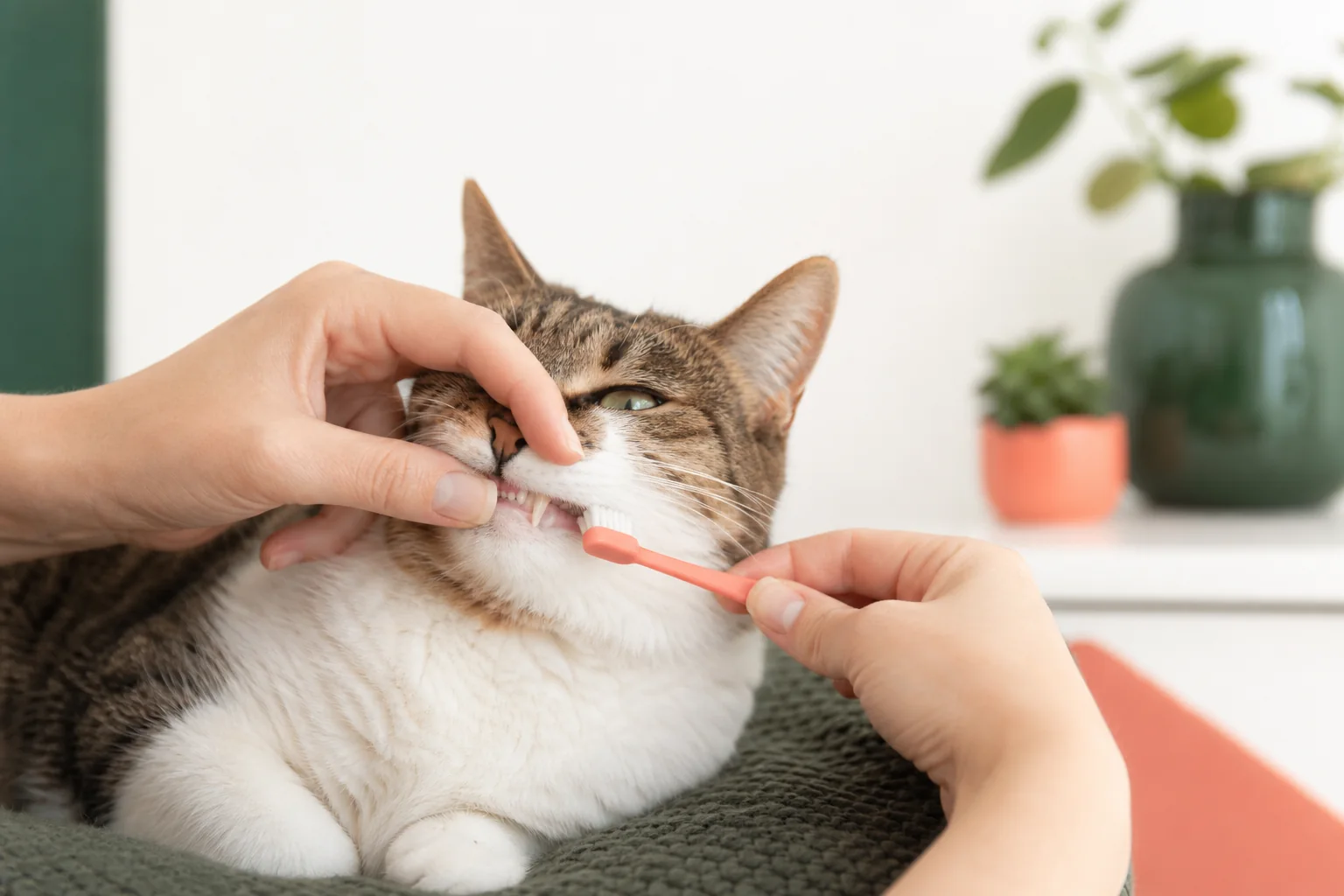
Short, successful sessions are more useful than restraining a struggling cat to finish the whole mouth. The detailed guide to brushing a cat’s teeth covers positioning, stop signals, and a progressive routine.
Brush the Outer Tooth Surfaces Gently
You do not need to hold the mouth wide open. Lift the lip and focus on the accessible outside surfaces, where plaque commonly collects. Use light, controlled strokes at the tooth-and-gum margin. Avoid pressing hard, pushing the brush toward the throat, or continuing when your cat pulls away repeatedly.
Daily brushing is often presented as the goal because plaque reforms quickly, but the right starting frequency depends on the cat’s current oral health and tolerance. The American Veterinary Medical Association’s pet dental guidance explains that regular home care works alongside veterinary dental examinations; it does not replace them.
When Not to Brush
Do not brush through pain. Bleeding gums, swelling, loose or broken teeth, drooling, persistent bad breath, pawing at the mouth, facial sensitivity, difficulty eating, or a sudden appetite change can indicate dental disease. Severe gingivitis and periodontal disease can make brushing painful and require professional evaluation.
Stop the home routine and contact a veterinarian when those signs appear, when a cat reacts strongly to gentle mouth handling, or when you are unsure whether the mouth is healthy enough for brushing. The Cornell Feline Health Center explains common feline dental diseases and why an oral examination matters. Tooth brushing supports prevention; it cannot diagnose disease, remove hardened tartar, or treat an infected or painful mouth.
Common Cat Toothpaste Questions
Can kittens use cat toothpaste?
Check the product’s age and species directions and ask your veterinarian, especially if a kitten is teething, has mouth sensitivity, or has not had an oral examination. Early handling practice can focus on a calm cheek touch and brief lip lift before toothpaste is introduced.
What if my cat dislikes the flavor?
Stop instead of adding more product or forcing the mouth open. Return to a comfortable handling step, then ask your veterinarian about another appropriately labeled flavor or product. Disliking one flavor is never a reason to use human toothpaste.
Can I practice with water only?
A clean, damp pet toothbrush can help a healthy cat learn the physical steps if your veterinarian has not advised otherwise. Introduce the toothpaste separately so you can tell whether the brush, handling, or flavor is causing hesitation.
Does toothpaste replace tooth brushing?
Not automatically. Dental products make different claims and must be used according to their labels. Mechanical brushing remains an important part of home dental care when a cat accepts it safely, while veterinary examinations remain necessary even with a consistent routine.
Do dental treats replace brushing?
No single treat or product replaces a complete dental plan. If brushing is not currently possible, ask your veterinarian about appropriate options and look for a VOHC-accepted product with a claim relevant to your goal. Recheck the species, calorie, and feeding directions for the individual cat.
Educational content reviewed for source accuracy July 26, 2026. Stop home brushing and contact a veterinarian if there is pain, swelling, persistent bleeding, loose teeth, appetite change, or difficulty eating.